Although Indonesia has become a country that has ratified CEDAW(Convention on the Elimination of All Forms of Discrimination Against Women), this does not guarantee that the problem of discrimination against women in Indonesia has been resolved. There are still many issues of discrimination against women in Indonesia that are of concern to the UN CEDAW Committee. The implementation of the CEDAW Convention in Indonesia, including the CEDAW Concluding Observations, needs to be encouraged by various parties, including civil society.
One of the roles that civil society can play is by monitoring the state’s obligation to implement CEDAW. Monitoring the implementation of CEDAW is very important to be carried out by civil society in Indonesia periodically and continuously to be able to measure the progress of the CEDAW Convention, including how the progress of the implementation ofConcluding Observations by the executive, legislative and judiciary.
The results of this monitoring can be used as advocacy material to urge the state to carry out its obligations for the protection and fulfillment of women’s rights, as well as the elimination of discrimination against women. The results of this monitoring can also be used as material for the preparation of an independent report (alternative report) to the UN CEDAW Committee.
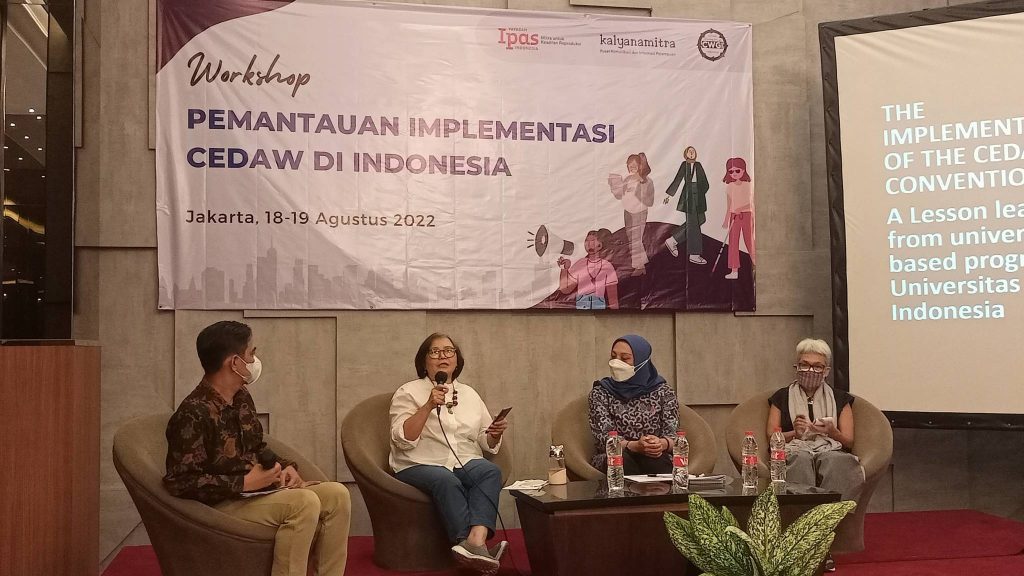
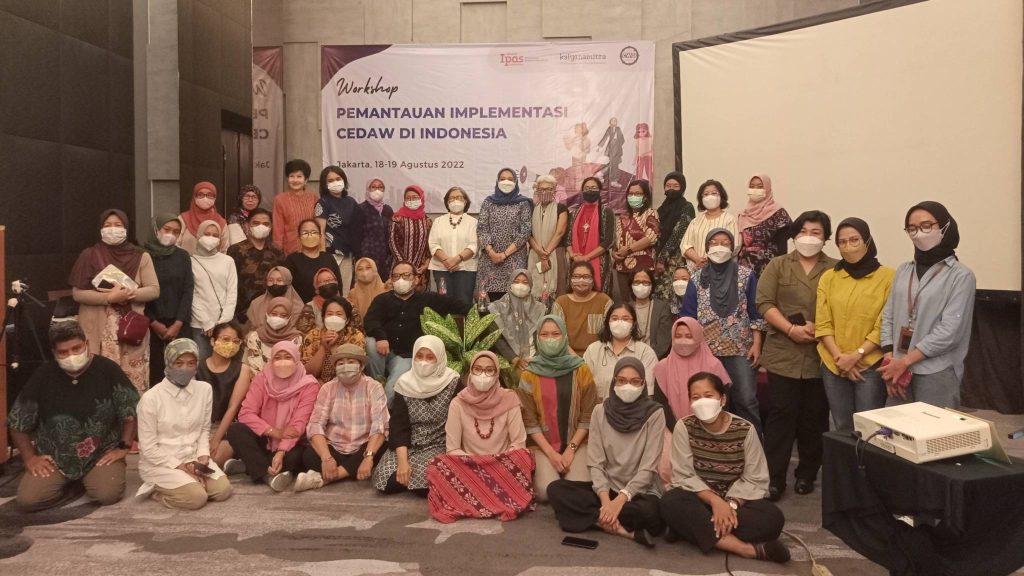
The series of activities initiated by CWGI officially began in August 2022, with the holding of the CEDAW Implementation Monitoring Workshop held on 18-19 August 2022 at Akmani Hotel, Jakarta.
This activity was attended by 50 participants who were elements of civil society (women’s organizations) from Aceh to Papua. This activity is fully supported by the IPAS Indonesia, as well as other CWGI activities that will be held in the future.
If we look at the objectives of the workshop activities, then some performance has been achieved, one of which is the discussion of monitoring tools for CEDAW implementation, which has been owned by CWGI since 2011. The involvement of civil society groups or women’s organizations from various regions in Indonesia was also able to provide discourse and information that was developing and then integrated into the CEDAW monitoring tools.
The CWGI joint project aims to support relevant ministries to have work plans that respond to the 2021 CEDAW Committee’s Closing Observations Recommendation on Women’s Reproductive Health, as a result of the work of a strong civil society movement. It is important to reflect together on the implementation of CEDAW in Indonesia as well as review the CEDAW monitoring indicators, considering that in 11 years there have been many forms of discrimination against women that have not previously been accommodated by CWGI. The CEDAW monitoring indicators are expected to be a guide for civil society organizations and other relevant parties to analyze the extent to which a state’s policies and programs have complied with the provisions of the Convention, and assess how far the state’s accountability and responsibility in implementing the CEDAW Convention both at the local and national levels. (*)