Public discourse on sexual violence can be built, perpetuated and challenged through narratives in the mass media. So how have these narratives been viewed by media actors and civil society groups?
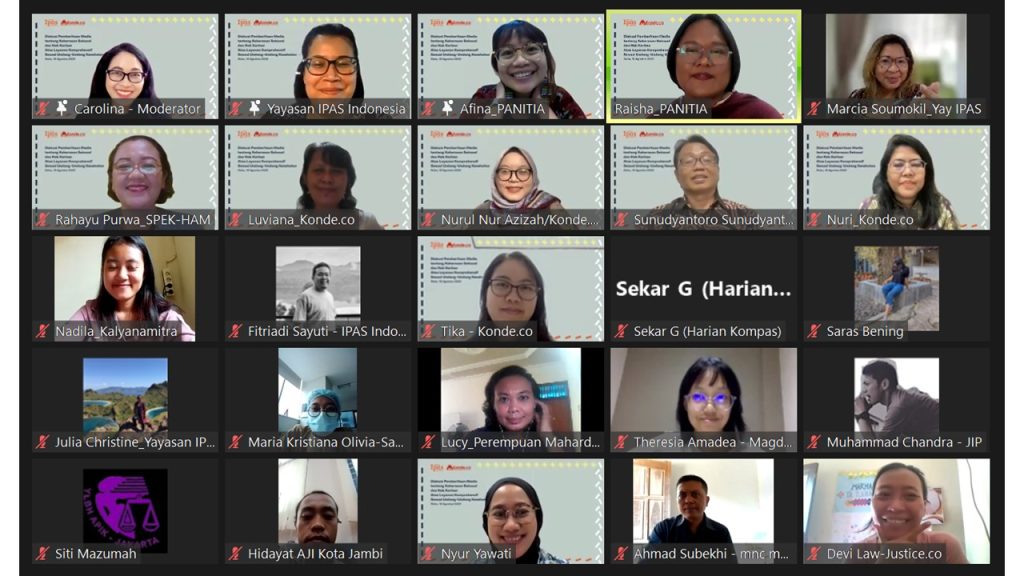
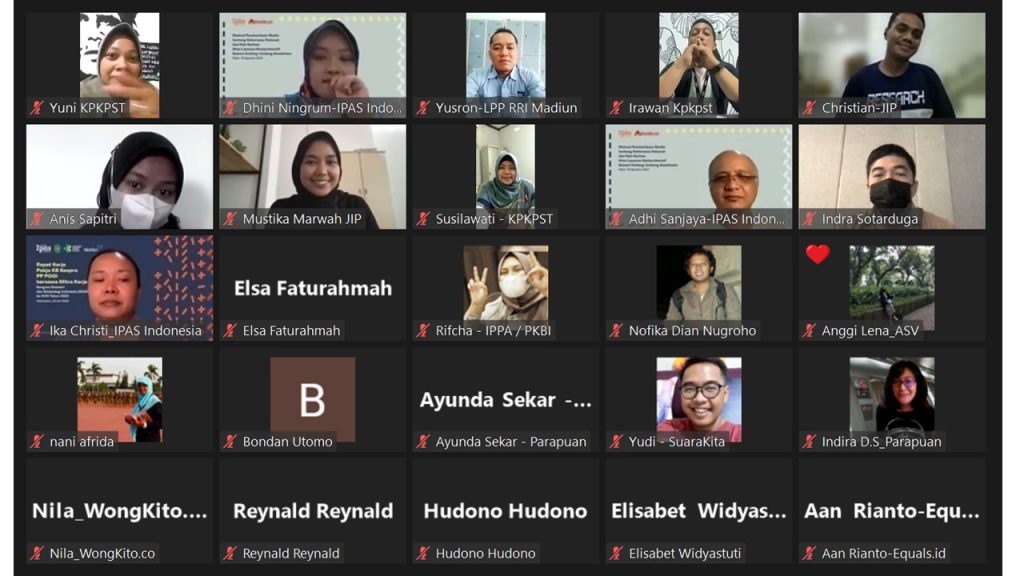
IPAS Indonesia held a public discussion on media coverage of sexual violence and victims’ rights to comprehensive services in accordance with the Law on August 10, 2022 online. The event was attended by approximately 60 participants from a network of civil society groups working on Sexual and Reproductive Health and Rights (SRHR) issues and national, local and community media networks.
The three main agendas of this discussion were to reintroduce the issue of comprehensive services for rape victims, obtain additional data and information for study enrichment, and agree on potential cooperation with the media on the issue of Violence against Women and Children (VAW) and Gender-Based Violence (GBV).
The event began with a presentation of the results of research on the reporting of the issue of comprehensive service rights for rape victims in accordance with the law by the Konde.co research team. The research, which was conducted in collaboration with the IPAS Indonesia and Konde.co, produced several important notes, among others:
- The media is busy reporting on the issue of sexual violence only when it is being discussed, if it is not being discussed by the public then the media does not raise it. The media lacks expert sources who can provide an objective perspective.
- The media’s lack of understanding of the issue from a legal and medical perspective creates a huge stigma and fear of offending social and religious norms.
- Media crews are limited in their coverage due to the large number of daily news targets.
The results of the research received positive responses from the resource persons present, namely Siti Mazumah, Director of the Apik Legal Aid Institute (LBH Apik) Jakarta, Rahayu Purwaningsih, Director of SpekHAM, and Sunu Dyantoro, Managing Editor of Koran Tempo.
Siti Mazumah, for example, welcomed the results of this research and discussion because it was like getting a new spirit in assisting victims. According to her, comprehensive services for rape victims are like a silent road because victims have to bear everything themselves, undergo legal processes and are often blamed. She said that as a companion, she did not dare to reveal the case to avoid the victim being victimized, especially during the case. As a result, it is difficult for victims to access the right to comprehensive services to prevent pregnancy due to rape in accordance with the law.
“Hopefully this can be a good start to fulfill the rights of victims because the rules for regulation actually exist but there are so many obstacles and implementation and we feel that,” said Zuma.
As we know, safe abortion services for rape victims are protected by Health Law No. 36 of 2009 article 75, as well as Law No. 12 of 12 on Sexual Violence (TPKS). However, the reality on the ground is that it is still difficult to access these services, and options such as pregnancy termination are not given to women so that the consequences become long. This was conveyed by Ayu from SpekHAM.
“The impact of the absence of services for victims includes survivors of violence at risk of becoming perpetrators of violence (throwing babies, killing babies, etc.), criminalization of victims and victims losing control over their bodies,” Ayu said.
Ayu continued other adverse impacts such as when survivors are forced to continue their pregnancies and become single parents, which affects the quality of children’s health, stunting, not being able to care for children properly, infant mortality, and cut off access to education, potentially entering the poverty cycle.
“If the survivor is forced to marry the perpetrator, there is also a risk of continued violence, mental health and psychiatric disorders, severe trauma, and depression,” she continued.
The realities on the ground, as conveyed by civil society groups as advocates, should be conveyed to policymakers that comprehensive services for rape victims are essential. This is where the media plays a crucial role. This is as stated by Dr. Marcia Soumokil, Director of the IPAS Indonesia.
“The role of the media is very important as part of the pillars of good public service governance, such as how the media plays a major role in supporting and encouraging advocacy for the fulfillment of victims’ rights to receive all services for their recovery, putting pressure on policy makers to implement the regulations that have been made, and providing education in shaping public perception,” said Dr. Marcia.
Sunu Dyantoro from Koran Tempo realized the shortcomings in the quality of media coverage of sexual violence cases, including reporting from the perspective of victims.
“A lot of media news is not in favor of victims, exploiting victims, revealing victim information to the public, full of stereotypes and stigma. The results of this research are a criticism for journalists to work more professionally, this research is essentially a guardian of our journalism soul, without us needing to pay for it,” he said.
Iya added that not all journalists have a good perspective on the issue of sexual violence against women. New journalists enter the newsroom almost every year, most of whom do not have adequate perspectives on many issues, including rape and the right to abortion. While some newsrooms have education and training mechanisms for their journalists, others do not.
So according to him, it is very important to increase the capacity of journalists for many issues, including the issue of rape and the right to safe abortion for victims. In addition, it is also necessary to keep refreshing the editor’s memory and perspective on how to report correctly on the issue of rape and the right to abortion.
The discussion was complemented by questions and answers from the participants to the resource persons. Participants were very enthusiastic in exploring the phenomenon of the implementation of the rights of rape victims in Indonesia. Even the media’s awareness to be more comprehensive in being friendly to victims in reporting on the issue of sexual violence is increasing.
The key to unraveling the tangled threads of realizing comprehensive services for rape victims is the collaboration of all parties, both civil society and the media. IPAS Indonesia Foundation will always support all steps to realize comprehensive services for victims of sexual violence in accordance with the law.